
Claire Valdez on Mamdani, AOC, and Her Campaign for Congress in New York's 7th District
The New York Editorial Board's interview with Assembly Member Claire Valdez, a Queens Democrat running for Congress in New York's 7th District.

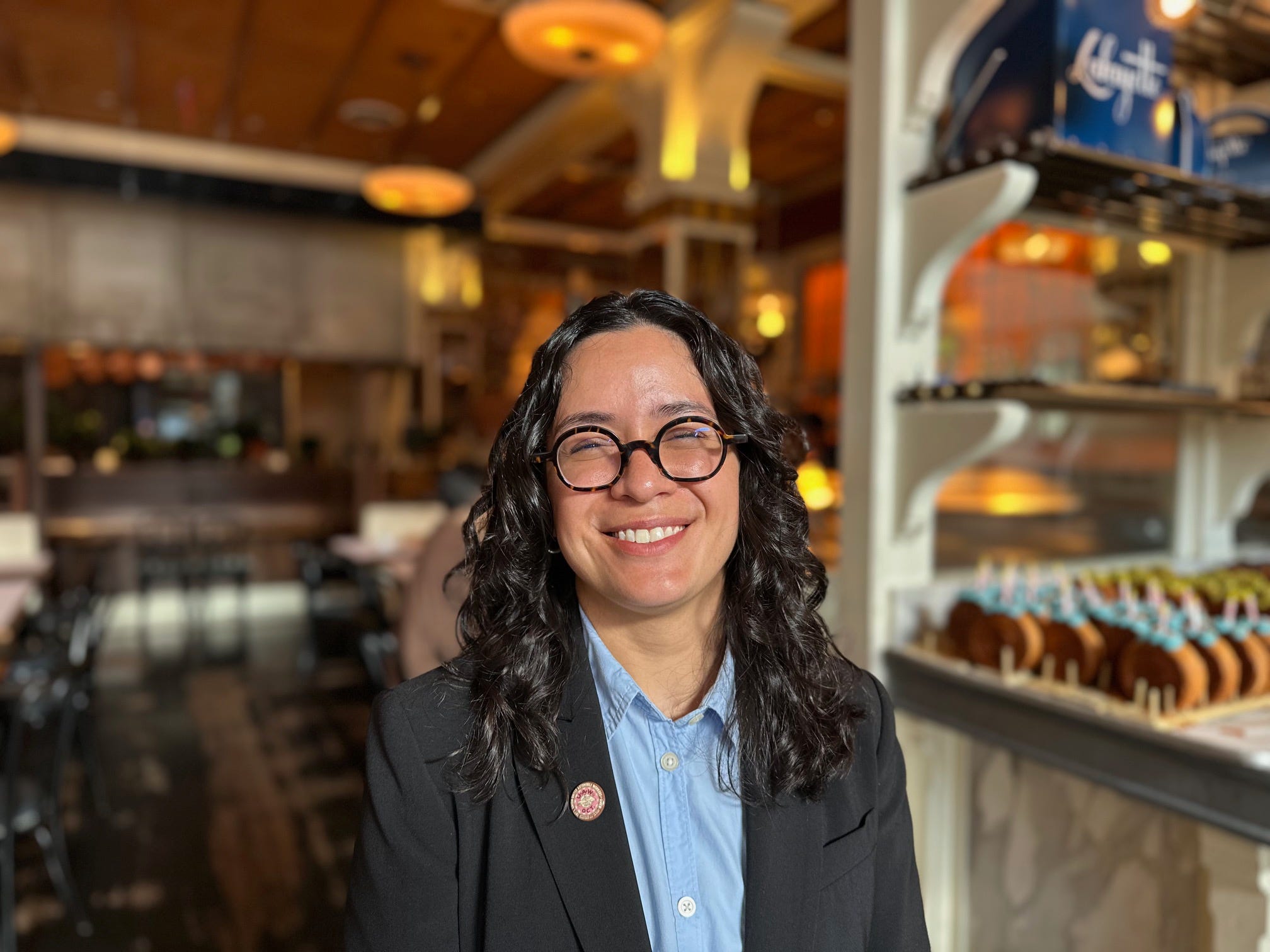
The New York Editorial Board spoke with Assembly Member Claire Valdez of Queens about her campaign in the Democratic primary for New York’s 7th Congressional District (parts of Brooklyn and Queens) on the morning of April 24, 2026. Valdez, a democratic socialist endorsed by NYC-DSA and Mayor Mamdani, is among the candidates running to succeed retiring Rep. Nydia Velazquez. The primary election will take place in June. (photo by Liena Žagare)
Participating journalists: Nicole Gelinas, Christina Greer, Ben Max, Akash Mehta, Myles Miller, Harry Siegel, Ben Smith, Liena Žagare.
Full Transcript
Ben Smith
Thanks for coming in. I always say this but it’s also true: In the old days, I’d say the editorial board of the Daily News would have been able to, like, muscle you in through their sheer political power. But now politicians get to decide whether or not they speak to journalists, so we appreciate that you do. Chrissy?
Christina Greer
Again, thank you. Can you just lay out the land of the district, tell us different demographics of the district, the different issues of the district, and how you plan to address the varying, quite diverse factors.
Claire Valdez
As you all know, it’s a big district. It spans Brooklyn and Queens: Long Island City, Astoria, Sunnyside, Woodside, Maspeth, Greenpoint, Bushwick, Williamsburg — I can run through the entire geography of the district. But it’s incredibly diverse. It’s full of immigrants, workers. Many artists live in the district, which is something that I’m very passionate about myself. There’s a large Hasidic population in Williamsburg. There’s a big Latin American diaspora throughout.
And it’s overwhelmingly tenants. It’s a 77 percent tenant district. And those tenants live in market-rate housing, NYCHA, and rent-stabilized housing. It really runs the gamut and the spectrum, and it’s an issue that really unites every single part of the district. Everywhere we go in this campaign, people are talking about rents going up and how unsustainable that is. We know that this district has seen a lot of displacement and development over the last couple of decades. I live in Ridgewood. My rent just went up or will be going up, on May 1st, unfortunately.
Ben Smith
From what to what?
Claire Valdez
It’s going up a hundred bucks. To $2,350. It’s actually a good deal.
Nicole Gelinas
It’s market rate?
Claire Valdez
It’s market rate. My landlord has, I think, two buildings on the street. Pretty traditional New York small landlord. But housing is a real issue. People are worried about being displaced from their neighborhoods. People are unsure if they’ll be able to put down roots for the long haul and raise families in the neighborhoods that they know and love. And so that’s really an issue that unites, truly, the entire district, but everyone’s feeling the same kind of affordability crisis that so much of the last year and change has been about.
Childcare costs. We hopefully are, we’re mitigating now, but obviously a big expense. Utility expenses are really high and going up all the time. So people are feeling the pinch in a lot of different ways. I think a sense that people can’t live sustainable lives in New York, and people’s wages aren’t going up. I think this is one of the issues that really brought me into politics, is the fight for workers to be able to set the terms of their working conditions through unions.
But wages are stagnant, costs are going up, and this is very much what our, my, platform has been about. And the reason I wanted to run for Congress is to address all these kinds of various issues that are forcing people into real states of precariousness. And that’s a general sense, I think, throughout the entire district, that we’re finding as we knock doors and talk to people.
Christina Greer
So how does the role of a Congressperson help mitigate some of these issues? Because some of this seems like a City Council member or even a state legislator could do that. So where do you see yourself working in Washington, DC, to change these things?
Claire Valdez
Absolutely. I come out of the labor movement, I come out of organizing within my shop at UAW – at Columbia University and in UAW. And what we know is that federal labor policy is stymied, organizing not just in New York State and New York City, but all over the country. And it’s my opinion that in order to build up our democracy, in order to raise wages and lift the floor for all workers, we need to get as many people as possible into unions. And that’s federal policy that has to be addressed at the federal level.
We deal with cases of ICE in our neighborhoods. When a teenager from Grover Cleveland High School was kidnapped from an immigration hearing last year, that’s a federal policy issue that we have to address.
And so we can do work at the state level to fight for a budget that is equitable and just, to advance immigration policy at the state level. But so many of these problems have to be addressed at the federal level, legislatively. And of course, fighting for more resources for our communities. The federal government has a lot of money. We want to bring that back to our district as well.
Ben Max
You’re relatively new to the Assembly. You’re from the DSA movement and organizing work. You’re endorsed by the mayor. Do you think if Zohran Mamdani had lost a relatively close race to Andrew Cuomo last year, you’d be running in this race? How has that victory for the movement sort-of propelled you to make this decision, and do you think you’d be running if he hadn’t won?
Claire Valdez
I think the mayor’s race demonstrated that there is a broad constituency that is maybe open, more than we previously thought, to a democratic socialist vision for an affordable New York, for a just and equitable society, in which people’s real material needs are foregrounded against corporate interests. And that is very obviously inspiring to me. It’s the product of many, many years and many, many people organizing across a lot of different districts in a lot of different races, and really doing the work to talk to our neighbors. And we saw his, the mayor’s race, really electrify a constituency, that I think had felt pushed out of politics for a long time.
I certainly never saw myself in politics. Like I said, I come out of organizing in my shop and knocking doors for people like Bernie Sanders, but I never saw myself on the mailer. And I think I, I thought that for a long time, because politics felt like this very rarefied field, where you have to have the right degree, the right credentials to participate, and I think what DSA has done very well is to show people that actually, anyone can run these races. Working people can come together and strategize and gather resources and recruit candidates and run these races.
And the mayor’s election proved that people are really attracted to having a seat at the table and wanting to participate in those campaigns. You know, a hundred thousand people volunteered for that mayoral campaign. We’ve never seen anything like that in New York City. And so I think we’re coming off of the heels of this really momentous election, and just moment, in New York City history and time when everyday people felt compelled to organize together. And that’s energy that I am bringing into this campaign. We obviously are working with many of Zohran’s team, former team, and many people who were leaders in the field work, too, are organizing with us now. So I think it feels hard to imagine trying to launch a really ambitious campaign without the success of that one.
Ben Smith
Can I just pause on one thing you said, about credentials, because it seems like actually the DSA is often representing people who do have a lot of credentials, but aren’t that happy with how their careers are working out. And a lot of its leaders, you know, Bernie went to University of Chicago, Zohran went to Bowdoin, and you’re a graduate student organizer. It’s not people with – it’s people with quite, you know, kind of, on paper, credentials that are actually probably fancier than those of the machine, machine Democrats that they’re looking to replace and displace, so I’m just curious what you meant about that?
Claire Valdez
I’m sorry. Did you say I’m a graduate student organizer?
Ben Smith
I’m sorry, you weren’t—
Claire Valdez
No, you’re OK. There’s a lot of, there are many different unions on Columbia’s campus. So, I was a clerical worker organizer. So, I was an administrative assistant in the kind-of support staff union. And worked to organize with mostly administrative assistants, but also some cafeteria workers, call-center workers, print-shop workers, the support staff of Columbia.
Ben Smith
I’m curious to the broader point. Do you feel like the kind of Joe Crowley, Antonio Reynoso Democrats, that the issue with them was that they have too many credentials? That was the part that I was confused about.
Claire Valdez
No. So I meant more that I think before I got involved in DSA, my sense of campaigns was very much that consultants ran them — which may actually be true in a lot of campaigns. [Laughs] But that there was a kind of credentialism for the way that campaigns are spun up and run. And that’s not, that doesn’t have to be the case.
Myles Miller
A follow-up about representing administrative assistants. My mom was an administrative assistant, so I know the life. I wonder how you square the message of your campaign for state office, and this Ridgewood Reddit group was up in arms: She says she’s working class but she comes from a father who’s an electrical engineer--
Claire Valdez
Civil engineer.
Myles Miller
Civil engineer, right. How do you square the working-class message with your upbringing, and do you think that plays a role at all to what you’re fighting for?
Claire Valdez
I’ve been working jobs since I was a teenager and I’ve bagged groceries; everyone likes to talk about how I worked at Taco Bell; I worked at Trader Joe’s for six years. I, like many, many people in New York City, did not set the terms of my employment. I didn’t set my hours, didn’t set my own wages. And that’s an experience that I think many people at this table and many people in New York have had. And I think that’s a really important one. That’s where my politics come from, is a sense of not having control over my life, not having control over my schedule or being able to plan ahead. There were times in my life working seven days a week where I was still overdrafting my bank account.
My union was the thing that introduced me to the idea that actually you can have power in the workplace. You can fight for the better working conditions and better wages, and you can win something really basic, like a nine-to-five and overtime, things that I think every worker should have. Maybe not a nine-to-five, but having set hours and having overtime and good benefits.
And I think we need more people who have a direct experience of that kind of transformation, of feeling formerly powerless, stepping into power, organizing for even more, with a real deep understanding of the fact that so many workers are locked out of feeling that kind of power. I think that’s a really important experience to foreground in this campaign.
Harry Siegel
I’m a little confused by that. I worked all sorts of random jobs with bad hours and such things, and overdrew my bank account, but I had family resources to benefit from. And you’re saying that’s what we need from our representatives. But I wanted to ask, you brought up advisors and those people messaging campaigns. I saw Morris Katz, I think in City and State right when you were coming in, saying something like, this is the most important race and is gonna define things. I was hoping you could talk a little about that and what’s at stake here, because it’s clearly a race a Democrat is going to win [in November]. And I think for people who aren’t following it closely, maybe the differences between a DSA candidate and a progressive candidate aren’t so obvious.
Claire Valdez
No, I think that’s a really good question. And I think the reason the stakes of this campaign are very high is because this is a very progressive district, as we all know. It’s very left-wing. And I think that from this seat, and we’ve seen this leadership of Congressman Velázquez, too. She’s been a very progressive and bold champion for workers, for immigrants, against colonialism for her entire life. And this seat represents the opportunity to continue that legacy and really advance a very progressive and even democratic socialist vision for what federal policy can look like. And so I think this is a really important race for that reason, that we can be the kind-of tip of the spear on a lot of different issues.
Harry Siegel
Can I just ask then, because obviously she’s endorsed another candidate in the race. There was reporting in the Times about her speaking privately with the mayor about trying to find someone [together]. Why is there a need for some sort-of ideological, in some ways generational, change in the district now?
Claire Valdez
Why there’s a need for—?
Harry Siegel
You’re saying these things about Velázquez and her legacy, and you’re also not the candidate she’s endorsed. There was all sorts of background conversations about this, reportedly. So, why someone, other than who she thinks should come in next, is the right person to fill the seat now?
Claire Valdez
I think the— again, I really admire the Congresswoman. I’ve told her this directly, and will continue to say that I think she’s been an incredible champion for the district. It’s not, I think, a normal circumstance where you can say that actually my Congressperson is really great. [Laughs] And I have been fortunate, while living in the district, to be able to say exactly that.
I’m running because I think we need a unionist to go to Congress. There’s a reason that this campaign and this moment spoke to me, as reluctant as I was to take the swing. Because we need to advance a pro-worker labor agenda at the federal level to build union density across the entire country. And I think coming out of being an organizer in my own union, being on the bargaining committee, standing shoulder to shoulder with my coworkers in really difficult grievances and disciplinary meetings, and going toe to toe with a university as powerful as Columbia, those are experiences that I think are sorely needed.
I think there’s only a handful of Congressmembers who have any direct relationship to the labor movement, who have been union members themselves. So if you think union density in the country is low, in Congress it’s even worse. And we can change that in this election and that’s what I’m fighting for.
Liena Zagare
Unionizing can be very contentious. So I wanted to understand how you think about compromise, because that and any other number of big burning issues would be front and center.
Claire Valdez
Yeah, when I think about questions like this, I think back to my unit at Columbia, 500 people strong, and a very, I would say, politically and ideologically mixed unit. By no means a lefty group of people.
And what would unite us all would be contract negotiations — coming together to decide what we are willing to fight for, if a strike would be on the table, where we would want to move in negotiations with Columbia. And compromise comes in, I think, especially when we’re talking about bargaining committees and things like this, because you are evaluating how much power you have to actually push, if a strike is even possible, where that power is going to come from.
And so you can make those determinations at the table: What, if any, concessions you’re willing to give, and that’s a lot of what my union taught me, is how to talk to people about the things that really matter to us. Wages, childcare, benefits — gosh, what else were we bargaining for?
Those are the big things. And I think being able to kind of align on the things that are essential to the contract, when we’re going up against something, someone, an entity as powerful as Columbia University, is the first step.
Then we start thinking about, what can we give, what can we refuse to give, and do we have the actual power to withstand that? So, compromise, it happens. But I think there has to be real power analysis, to think about if we can actually, if sacrificing something is worth it in the pursuit of a better agreement overall.
And certainly in the New York State Assembly, we talk about compromise all the time. We are in the midst still, somehow, in negotiating a $263 billion budget. And there’ll be compromises on the table, absolutely. So we’re evaluating those as conversations go on, but on the whole it’s about finding, identifying the kind of, if there are red lines, how to navigate those, and evaluating how much power we have to push back.
Akash Mehta
Two questions about power relations within the State Assembly. You talked in your first campaign about how being a union organizer made you realize that the bargaining table is the place where you become more powerful than your boss. In one sense, [Assembly Speaker] Carl Heastie is your boss. He makes the decisions for the chamber. How do you assess his leadership, and how have you organized to influence it?
Claire Valdez
My constituents are my boss. I think Carl does a good job, I think, of balancing many different interests, and he’s negotiating between super-progressive districts like mine, and much more marginal districts, further away from, maybe outside of New York City or even within New York City. And I think he has done a good job of hearing people out and giving people the opportunity to speak and to air the things that are most pressing in our districts. The things that we are really concerned about.
And I’m grateful for that leadership. I think, ultimately, the New York state budget and so many decisions that are made in Albany, are made by three people in a room. And it can be really hard to influence that very closed node of power. What I, and many of my colleagues right now, are frustrated by, is that we have a budget that’s 24 days late.
And rather than talking about the things that really matter in our districts or the things that matter to, I think, the health of New York State, like raising revenue on the wealthiest New Yorkers, making sure that we’re filling holes left by the Trump administration’s cuts to to SNAP and Medicaid, that we’re still stuck on kind-of policy — the governor’s proposed policy changes that are in the budget. And it’s incredibly frustrating that’s where we are, instead of talking about things that actually make our constituents lives better and can improve New York State.
Nicole Gelinas
So I have two questions about the state budget.
One, since the [Governor Andrew] Cuomo years, it’s been a habit to put all these policies into the state budget as you just described. Is that bad? And if so, why haven’t the Democrats in the Legislature been able to stop it?
Claire Valdez
I am of the opinion that it is bad. I would much rather us spend time negotiating policy changes on the floor of the Assembly and talking about those things as we would any other pieces of legislation. Because yes, as we’ve seen over the last couple of years, adding these Article 7s has made it much harder to just move through the budget process.
And we’re looking at these very late budgets that prevent us from talking about the budget items that are actually really important, or even funding to organizations in our districts that are relying on state funding. There’s a lot of things that are being held up right now.
But the downstream effect, then, is that we have even less time to do, to pass real legislation in the rest of the life of the legislative calendar. We’re wrapping up in early June this year. It’s now late April. We’re really looking at a short runway to pass our priority agenda, legislative priorities and things that, I think, would materially improve New Yorkers’ lives.
So I find it incredibly frustrating that Article 7s have been inserted into the budget, are gumming up this process. And I know that Speaker Heastie has spoken about this before, too, and expressed some frustration. And I hope that we can change it in the future and push back against this kind of impulse to add more legislation to the budget.
Nicole Gelinas
And Mamdani obviously ran and won on $9 billion worth of annual tax hikes from Albany. It doesn’t seem like that’s going to happen. Why is that? Why can’t the DSA contingent of the Democrats show enough power in Albany to get these tax increases passed?
Claire Valdez
I am very happy to see the pied-à-terre tax come forward. That’s, it’s not the biggest chunk of change, we know — looking at maybe $500 million. It is definitely a start. But it’s not the end of how much we need to raise, and how much we want to push back on, I think, a lot of corporate power within New York City and New York State.
So there’s much more organizing to do. We are, I’m sure you all saw, there’s an action in Governor Hochul’s office yesterday, where a number of people were arrested while they were demanding additional taxes on the rich. We’ll keep doing actions and trying to popularize this idea. I should say, it doesn’t need to be popularized anymore. It is consistently shown to be, to have majority support throughout the state. And that support crosses political lines too. I think most New Yorkers want to see taxes raised on the very wealthiest New Yorkers and most profitable corporations.
So I don’t know why the governor refuses to listen to her constituents, who have been calling for this for a long time. And whose healthcare systems and housing would be vastly improved, if we could make meaningful investments that come from those taxes.
Nicole Gelinas
And would that be a failure for the mayor? This is his most powerful year. He’s got his backing as enthusiastic as they’re ever going to be. If he can’t do it this year, is that a failing on his part?
Claire Valdez
The governor wields immense power in the state. And especially, vis-a-vis, gumming up the state budget and taking her time in passing it, and just, we haven’t even been able to talk about fiscals yet because we’re stuck talking about her legislative priorities. I think it’s a real problem and we, there needs to be reform there.
Like I said, we’ve been organizing to tax the wealthiest New Yorkers for a long time, and that fight continues.
Ben Max
Did he [Mayor Mamdani] make a mistake when he endorsed her [Governor Hochul]? Was that too early and he gave up leverage in a lot of this, and not going to tax the rich rallies in Albany or with Bernie Sanders? Was that a tactical, strategic error?
Claire Valdez
What I’ll say is, I have not endorsed the governor. I have no intention to do so, I think, without some pressure of a election, I think, it’s hard to get her to move on some of our priorities. So I think, I haven’t endorsed her. I don’t have any plans to do so, and I’m hopeful that in an off, in a non-election year, maybe we’ll see some movement on these other priorities, but we’re still negotiating the budget.
We still have probably at least a few more weeks, a couple more weeks, left before this budget is done. And in that time, we’re gonna keep organizing both within the State Legislature and on the outside to get as many, to get as much revenue raised as possible.
I should say, too, this isn’t just a DSA priority. This would meaningfully impact working people’s lives in New York City and New York State. We’re looking at people who are about to be kicked off of their Medicaid, could lose their health insurance. We see people who are struggling every single day to pay their utilities. There are real material costs to the working class if we don’t do this.
And that’s why DSA is not the only organization calling for revenue-raisers. We’re part of a very broad coalition of people from all over New York State who are fighting for this.
Christina Greer
I want to follow up with something you said, that we need more unionists. Who are some unionists? Already in Congress who you’d work with? And have you reached out to them?
Claire Valdez
So now I’m forgetting who the, my list of folks who have been in unions. But I’ll say that I’ve been in conversation with Congressmember Greg Casar, who has been a real friend of the labor movement for a long time, and done good organizing in Texas to advance the labor movement. And I look to a lot of his leadership on these issues, too.
But I think, in terms of people who have had a direct relationship to the labor movement, who have really been, like I said, on bargaining committees, been their shop steward, there aren’t very many. But I do look to Congressmember Casar as someone who’s done that work.
Christina Greer
But I don’t think that people necessarily have to have been in a union to be, say, unionist the way you laid it out. So are there any, say, New York members of Congress that you identified as wanting to work with closely? Let’s just say you get across the finish line, and you get to DC, who do you want your allies to be in this unionist mindset?
Claire Valdez
Yeah, I’ll point to Congresswoman Ocasio-Cortez as somebody who has been a real friend to labor for a long time, has stood with UAW in a lot of different fights, and as someone who I think is a real friend to workers and is gonna fight for federal legislation that will make it easier to unionize and will push back on the corporate greed that has made it, made this political landscape so difficult for workers to get into unions. So she’s certainly somebody whose leadership—
Myles Miller
Would you say you’re looking to make yourself in that image?
Claire Valdez
Congresswoman Ocasio-Cortez is a real leader in the United States right now, and certainly on the left is seen as, and I’ve seen her, as a real leader, and a real spokesperson for a movement to advance justice for workers and immigrants and pushing back on the Trump administration. And I have a lot of admiration for her. I got politically involved, so, I joined my union in 2018. I got politically involved around that time in part because you have some more time off and you use it for something, but it was also on the heels of seeing her get elected and seeing the kind of grassroots momentum that allowed that to happen. And so she’s definitely, I would say, a political icon, and someone that I look to—
Ben Smith
Would you urge her to run for president?
Claire Valdez
I certainly think she should run for something, I think she should run for higher office. I would love to see her run for president.
Ben Smith
Do you think she will, this cycle?
Claire Valdez
Well, we’ll see. I think…I think there are a number of places that she could use her political talent and organizing ability to succeed in—
Ben Smith
The Senate being the other.
Claire Valdez
I can see the Senate. I would be surprised if we don’t see a challenge to Senator Schumer in 2028 and I would love to see someone as fierce and as committed to building the movement as Congressman Ocasio-Cortez run for that seat or something else.
Nicole Gelinas
What would you say is her main accomplishment?
Claire Valdez
This might be a little intangible, but I think her real strength is in communicating to everyday people and demystifying or unobscuring the processes of federal government and opening that up to more people. I think this is why it’s really great to have incredible communicators like Congresswoman Ocasio-Cortez, like Mayor Mamdani, be in these positions, because so much of this has been obscured to working people for so long.
And working people are also busy, working two, three jobs, raising their kids. It can get, it can feel really easy to be shut out of the political process. And I think her ability to cut through the noise, to speak really directly, has been something that I found really admirable and found a lot of inspiration from.
Liena Zagare
Since you touched on working people, how do you think about growing the economy?
Claire Valdez
So part of my labor platform is a federal jobs guarantee. I really want to see the federal government investing in our economy, fighting to provide good jobs for people who want them, and making sure that people are employed in sectors like infrastructure or childcare, care for our elders — there’s so many places where I think we really need people to do good work. And I would like to see our federal government work to make that happen, and make direct investments in public works and good jobs for people.
Ben Smith
Do you think the private sector — I mean, we’re in a pretty low unemployment environment right now — do you think the private sector is too big? Would you like to see it shrink and the public sector grow? Just because, like, pretty low unemployment—
Claire Valdez
Yeah.
Ben Smith
So you would like to see workers shift from the private sector to the public sector?
Claire Valde
I think we can look at things like Con Ed and National Grid, maybe as good examples here. New York State has the New York Power Authority, which is a huge public authority tasked with producing energy. I would, I think, we’ve seen that private investments in fossil-fuel infrastructure and kind of non-renewable infrastructure, is incredibly expensive and we’re investing in that for the next fifty, hundred years.
And we’re continuing to pour money into infrastructure that is both bad for the planet, and that does not make our utilities cheaper. And so in instances like that, I would like to see state ownership of utilities, because I think it’ll make our utilities much cheaper. It’ll help us advance toward a green future and more renewable energy. And I think that’s a good investment
Akash Mehta
Hochul has directed the Power Authority to build five gigawatts of nuclear power. Is that a good idea?
Claire Valdez
I think we should be building public renewable energy, especially solar and wind. I think we have a plan for, we would like to see 15 gigawatts of public renewable energy to meet the state’s demand for energy.
And I would much rather see those investments go toward geothermal and wind and solar, in part because those things are faster to bring online. And we need to make that transition just as quick as possible. And I think we can, with enough investment. And right now we’ve got, I think, $200 million in our state budget for NYPA. We’d like to see that increase.
Akash Mehta
Could you talk more about just why nuclear is not on your list? It’s longer-term, is that the main reason?
Claire Valdez
That’s part of the reason. I think we, there can be a real path for, what we know to be reliable, renewable energy sources, like I said, solar, wind, geothermal, and we should be pursuing those.
Ben Max
Can I come back to the tax-the-rich effort. Do you agree or disagree with the notion that a lot of times the left leads with, we need to tax the rich and generate more revenue, and it’s not always clear what that revenue is for. I follow this stuff very closely and very often I’m hearing that message and not always — I think part of the reason the mayor was successful is he actually led with the deliverables, and taxing the rich was a way to get there. But it seems like a lot of the messaging, even some of what you started with, was we need to just be taxing the rich more. And the governor, her response in some of this — you’re not sure why she doesn’t come along — is, I don’t believe in raising taxes just for the sake of raising taxes.
Obviously there’s things that you want to pay for, but do you agree with that, that maybe that’s part of why there isn’t more, both — I know there’s popularity in the polling — but more support in politics and in the populace around the platform here? Do you think you’re clear enough about what the increased revenue would pay for, on the left?
Claire Valdez
This is a really good question, and actually it’s a really live question, I think, within the movement, is how are we messaging the necessity of taxing the rich? Because truly, the list of things that we could pay for is endless. I talked a little bit about healthcare. We can talk about public-transit infrastructure, infrastructure upgrades, putting elevators in at every [subway] stop, building 15 gigawatts of public renewable energy.
And winnowing that list down to something that feels really salient and immediate in people’s lives is frankly a challenge, because there are so many needs, people are being squeezed from so many different sides. And so I think we can do a better job of foregrounding the exact proposals that we want to see funded.
And like I said, we’re heading into this potential Medicaid cliff, where many thousands of workers might be pushed off their healthcare. I think that is a really good example of why we need to be raising revenue, and why it needs to be happening now, why we can’t wait for another election cycle, or whatever. I know people who are going to be losing their healthcare. And that’s a really frightening proposition for someone who might not have savings in the bank to get through the next few months if they don’t have it.
Christina Greer
Assuming Democrats take the House, would you support Hakeem Jeffries becoming speaker?
Claire Valdez
Right now, I’m really focused on getting through 2026, and being in a position where we do take back the House. And so I am a little wary of committing to making, to committing to voting for the speaker at this time. What I’ll say is that I really hope that Democrats can take back the House in 2026, and that the progressive challengers around the country are successful. And that within these campaigns, and by winning, that we can demonstrate that there is a new vision for what leadership should be doing in the Congress.
Ben Smith
Is there something that he could do to get you to say yes to that? Because it probably is, as you see in Albany, the most important vote you take, so it’s, I’m betting, voters might reasonably want to know your answer to it.
Claire Valdez
Yeah, I’ll say that there’s a lot of dissatisfaction in my district about the way that, the way that [Jeffries] has dealt with confronting the war on Iran. I think refusing to say we won’t commit to funding more of this illegal war is a real problem and people are angry about it. Rightfully so. … So I think there are things like that I think are real points of contention. And I’d like to see some change there.
Myles Miller
Can I just ask, you called the district a progressive district. And progressive and DSA are sometimes used interchangeably, coming from a progressive neighborhood. The DSA is such a different beast, whatever you want to call it.
Claire Valdez
Call it beast.
Myles Miller
Beast. But yeah, there’s some parts of the district that, you know, folks who’ve lived in Greenpoint for a long time, whether they’re Polish or not, or folks who’ve lived in South Williamsburg, who have lived there for quite some time. How do you differentiate yourself from a person who is so known in the district, and the issues that they have taken on for the last decade have been so germane to that district before, sort of, the DSA came in and said, we also care about these issues and we care about them a bit more and differently?
Claire Valdez
I think in this campaign, we are trying to advance a real vision for federal policy that speaks to working people and directly addresses the problems that are happening in our lives. I just spoke about the Iran war. Those are — that’s billions and billions of dollars that are being spent, rather than being spent here in our communities shoring up our hospitals and our public transit system.
This campaign is really about advancing a vision for what’s possible and what we can be pushing back on. How we take on corporate greed and the billionaire class, how we take on the military-industrial complex.
And I’ll say, I live in Ridgewood. I represent Ridgewood. There are many people who’ve been there for a very long time. And I’m proud that I’ve made good connections and good relationships with the people who have been in these neighborhoods and called them home very proudly for decades, or even in some cases, generations. My role as a legislator has really been, and on my Assembly campaign, within this one, is about going out and talking to as many people as possible about the shared vision, and how I want to make sure that people can stay in neighborhoods for the long-term and can truly enjoy the good life.
Ben Smith
We should ask a housing question.
Ben Max
I have a housing question. I guess it builds on that question, which is, again, obviously your seemingly top competitor in the race is the Brooklyn Borough President [Antonio Reynoso]. He’s taken a very all-of-the-above, very pro-housing-growth stance, including a real focus on upzoning and adding density to the lower-density parts of Brooklyn and the city more broadly. Do you agree with that? That general sense of, do it all on housing, including a lot more market-rate supply, but supply of all types and increasing density in some of the lower-density areas?
Claire Valdez
So one of the pieces of federal legislation that I’m most excited about, and there’s a sister version on the state side, is the Homes Act carried by Alexandria Ocasio-Cortez, that does a few different things. It puts more money into NYCHA; tt repeals the Faircloth amendment, so we can build more NYCHA developments; and it advances social housing as another option, for decommodified housing that’s permanently affordable and democratically managed by the people who live there. That’s also legislation carried by my colleague Emily Gallagher in the state, on the state side, that I’ve been very supportive of and very excited by.
I was in Barcelona in 2024, doing a tour of social-housing developments there. And they were beautiful. And it was a real demonstration of how the state can provide and build housing that’s, like I said, deeply and permanently affordable for people, that doesn’t cede power to real-estate developers who have a profit motive in mind — understandably so, they’re real-estate developers.
But I think the state can play a much more active role, in making sure that there’s housing that’s built that is outside of those market forces, so that people don’t have to worry about their rents getting raised all of the time.
I, like I said, I live in Ridgewood. We’re seeing rents go up like crazy right now. It’s not just mine. And this is a neighborhood that also saw, I think, the largest share of our rent-stabilized housing stock just disappear over the last few years. It’s a really, it’s a really frightening prospect, that we wouldn’t be able to stay in our neighborhood for the long haul.
Ben Max
Now Reynoso would say: upzone Ridgewood, you’ll have less pressure on rents, you get more supply into the market. Agree or disagree?
Claire Valdez
I think if we’re only talking about market-rate housing, I disagree. The market rate for one—
Ben Max
Almost any upzoning like that would be mixed-income — it would have to include Mandatory Inclusionary Housing, so it’d be mixed.
Claire Valdez
I think, again, what I am really interested in advancing in this campaign, and at the state level, too, is a vision of social housing and public housing that can, and a role that the state could play, in much more aggressively in making sure that the housing that we’re building is actually deeply, deeply affordable and protected from the markets, that, right now, are really squeezing me.
Ben Smith
Do you disagree with Mamdani on that, because I think he seems to think that you’re just not gonna hit the kind of numbers you want without the private market? Do you think he’s wrong about that?
Claire Valdez
I don’t think he’s wrong. Like I said, what I’m really, the thing that I’m very excited about is this model of housing that is, that has iterations in New York already that we should be continuing to—
Ben Smith
The federal government can afford 200,000, 300,000, 500,000 units of it? Or do you think, because Mamdani, I think, over the course of his campaign, kind of shifted on that…is he wrong?
Claire Valdez
No, I think in reality we’re going to have to, like private development is going to happen, and the role of elected officials will be in pushing as hard as possible to make it as deeply affordable as possible, and have as big a share of those units be deeply affordable and actually affordable for the people who live in the neighborhood and hope to stay there.
So there will be a mix. But I really want to be advancing a vision of housing that doesn’t rely on market forces to to be sustainable, because we can’t, we just can’t afford it. And the housing crisis is really, it’s really dire. People are being forced out of their neighborhoods right now. And I don’t want to see a New York City that’s hollowed out of working people.
Akash Mehta
This was right before you got to the State Legislature. But Governor Hochul, a couple years ago, had a housing compact that would’ve required every area of the state, including every community board district in New York City, to produce a certain amount of housing. And if they didn’t, the state would override their local zoning. And it also would’ve legalized ADUs across the state. Had you been in the Legislature at that time, would you have supported that, or not?
Claire Valdez
Candidly, I’d have to look at it, to know whether or not, but what I will say is that there are certainly communities that have not built their fair share of housing, that overdevelopment has been happening in certain parts of the district. Certainly Greenpoint, Williamsburg, Long Island City, have seen a lot of development, and that hasn’t been matched in other parts of the city or state. And so I’d be curious to look at it specifically before I make a yes no, but, the need for more housing is real.
Nicole Gelinas
The mayor seems like he’s supporting the redevelopment of the Chelsea Elliott [NYCHA] project, which depends on market-rate density to fund the public-housing portion. Is that a mistake for him to go ahead with that and should he rethink it?
Claire Valdez
It is a good question, and again, I think we are, we’re in a position because of really, decades and decades of disinvestment in our public-housing stock, where these are the decisions that would have to be made. What I’m really hoping in the coming years, and certainly as a Congressmember, is to fight for as much funding into our NYCHA as possible, so we don’t have to make these kinds of decisions.
That we can retrofit our buildings, that we can fix elevators, and that we can build more developments, too. The waiting list for these buildings is incredibly long. And bringing units up to code over time, doing asbestos abatement, all of that takes a long time. And requires a lot of resources. So what I’m hoping as a Congressmember is to fight for as much funding for NYCHA as possible. So these aren’t the tradeoffs that we have to be evaluating.
Ben Max
Short of $80 billion, though, like that [snaps fingers], are these the types of compromises that seem necessary in the short-term? Some people say this should really be a model: tear down the buildings that are falling apart, build new public housing and add some housing supply on the NYCHA campus. Is there something wrong with that? Is that a bad model?
Claire Valdez
Like I said, I think what I’m really hoping to advance, is a vision where we don’t have to make these kinds of compromises. I know there are many NYCHA tenants who are really frightened right now that this is going to be their reality. And the fact is, we live in an incredibly wealthy country. We live in one of the wealthiest countries this world has ever known. We should be able to make these repairs without making terrible sacrifices for the residents who call these homes.
Harry Siegel
I think we’re getting toward the end here. I feel like a lot of this has been, you implicitly offering but dancing around a theory of the case for what government could do, and how your election would fit in with that. I’m hoping you can talk directly about that, and also, because it’s complicated, with lawmakers…who your models would be for successful legislators. And you brought up Ocasio-Cortez, but it was strictly in terms of messaging. Maybe that is the theory of the case, is, more messaging gets more results. Your win would send that message to the Democratic Party, but pop that out.
Claire Valdez
So I think in this campaign, and really in my kind of political life, what I believe and hope to show people, is that the government can play, can be, a force for good in people’s lives. That it can, we can, be ambitious in our public works, that we can be ambitious in supporting workers who are trying to organize their unions. That we can be ambitious in the relief that we offer people, and that, in that process, people can become powerful actors in their own lives. I come out of organizing precisely because my union taught me that I don’t have to accept bad wages and bad working conditions. We can organize for something much better.
I think the Congresswoman — incredible communicator; I think so much of Congress is having a bully pulpit to communicate ideas, and advance a vision for what the economy should look like, and what our society should look like. But I’ll say it too, she has been a very effective Congresswoman. I think she’s brought a lot of resources back to her district. I think she has shown real leadership in moments where that is sorely lacking from some of our other Democratic leaders. And, in doing so, I think, helps make people more brave and more faithful in a democratic process.
And that’s really essential right now, when people either feel pushed out of politics entirely, don’t have faith in the federal government, don’t show up to vote in elections. I think that kind of demobilization and dissatisfaction is in part how we arrived at Trump’s presidency in 2024.
Harry Siegel
Very quickly, what message would a win from you send to the Democratic Party, in a race that a Democrat is going to win in November?
Claire Valdez
I hope that it shows that we can be, like I said, very ambitious. That what people are angry about is that their quality of life hasn’t changed. In fact, it’s gotten worse, that wages have been stagnant, that costs are going up, and it doesn’t feel like there’s anyone stepping in to help them.
I hope that this campaign can show that everyday working people organizing together can really change the political landscape in New York City. And that we need to be advancing a foreign policy of peace, of global cooperation, of solidarity in a moment when, certainly, this administration, but many others, have begun forever wars, and invested so much of our money in bombs and in and in war that no American wants to see.
Ben Smith
We’re nearly done. It feels like it would’ve made sense to end it on that very kind of high brow sweeping note. But actually this being New York, there’s a real local news question. I didn’t want to leave without asking.
Nicole Gelinas
Speaking of quality of life and the democratic process, your district suffered a street takeover by reckless drivers over the weekend, where one of them, clearly out of control of the vehicle, he came very close to hitting multiple pedestrians. That one of those vehicles had many speeding camera tickets. You support the super speeder bill to put automatic speed governors in these vehicles, but the [Assembly] speaker reportedly does not. What will you do in the next couple months to ensure that the super speeder bill passes?
Claire Valdez
This is certainly an excellent case study for why the super speeder bill is necessary. We see reckless drivers all the time get by and in some cases kill people, we’ve seen people killed in traffic violence by people who have, what is it, 16 points on their licenses.
This is a demonstrated pattern of behavior that, we know what the next step will be, injury, potentially death. And I think, the case in my district, this reckless driving, I think is a really important case, to be sharing with the speaker and be advocating for this piece of legislation to be passed. The governor included it in her budget. We have a real necessity, in the Assembly, to fight for it, and make sure that it passes, too, because people’s lives are at stake.
Ben Smith
To abstract that up, maybe a little, I think there’s a sense that you kind of see Mamdani wrestling with in real time: the left, people don’t trust the left, always, on issues of public order. I’ve seen, like Queens right now, there’s all sorts of stuff with — I was hoping, Nicole was more in the weeds than me — but obviously, neighbors are upset with kids drifting cars around, and stuff like that. And I’m curious, how big-picture you see that tension. Because it does seem like a lot of progressive governance in cities around the country has wound up falling apart over a sense that people don’t trust you to have these sort-of basic questions on order.
Claire Valdez
I think that we are, and you’re right, I think we’re seeing Mamdani wrestle with this in real time. I think, we have a democratic socialist mayor, who, in my opinion, is doing a pretty good job, improving the kind of quality-of-life in neighborhoods. We saw him very successfully dig us out of a snowstorm, a couple snowstorms. I think demonstrating that leadership can be successful has incredible downstream effects for the rest of us. And we’ll see how that plays out in the coming years.
But it’s certainly— I think quality of life issues are really essential to be addressing. And it’s something that my office in the Assembly, at least, has taken really seriously. We have an open-door policy for people to come in and chew our ears off if they need to or want to, and want to make sure that people feel safe and comfortable in their neighborhoods. Because a sense of chaos is a sense that government isn’t working for them. And that’s the exact opposite experience that we want people to have.
Ben Smith
Thanks for coming in.
Claire Valdez
Thank you.
The NYT has a substack? Why?